



If you’re seeking a way to make better use of your time, you might abide by the Latin axiom “Carpe Diem,” or “Seize the Day.”
But if you’re interested in helping rid Silver Lake near Mears of nuisance fish, you’d be better off subscribing to “Carpe Carp,” or “Seize the Carp.”
Confused?
Probably not as much as the thousands of carp that no longer call Silver Lake their home, ever since a joint effort by those interested in the lake’s integrity teamed up to trap and remove these hapless bottom feeders from this jewel of a lake in beautiful Oceana County.
“Clarity of the lake has been an issue for years, and nobody likes to swim in a soupy lake,” explains Tim Beggs, an Oceana County Commissioner and member of the Silver Lake Improvement Board, which works alongside the Friends of Silver Lake to eradicate carp.
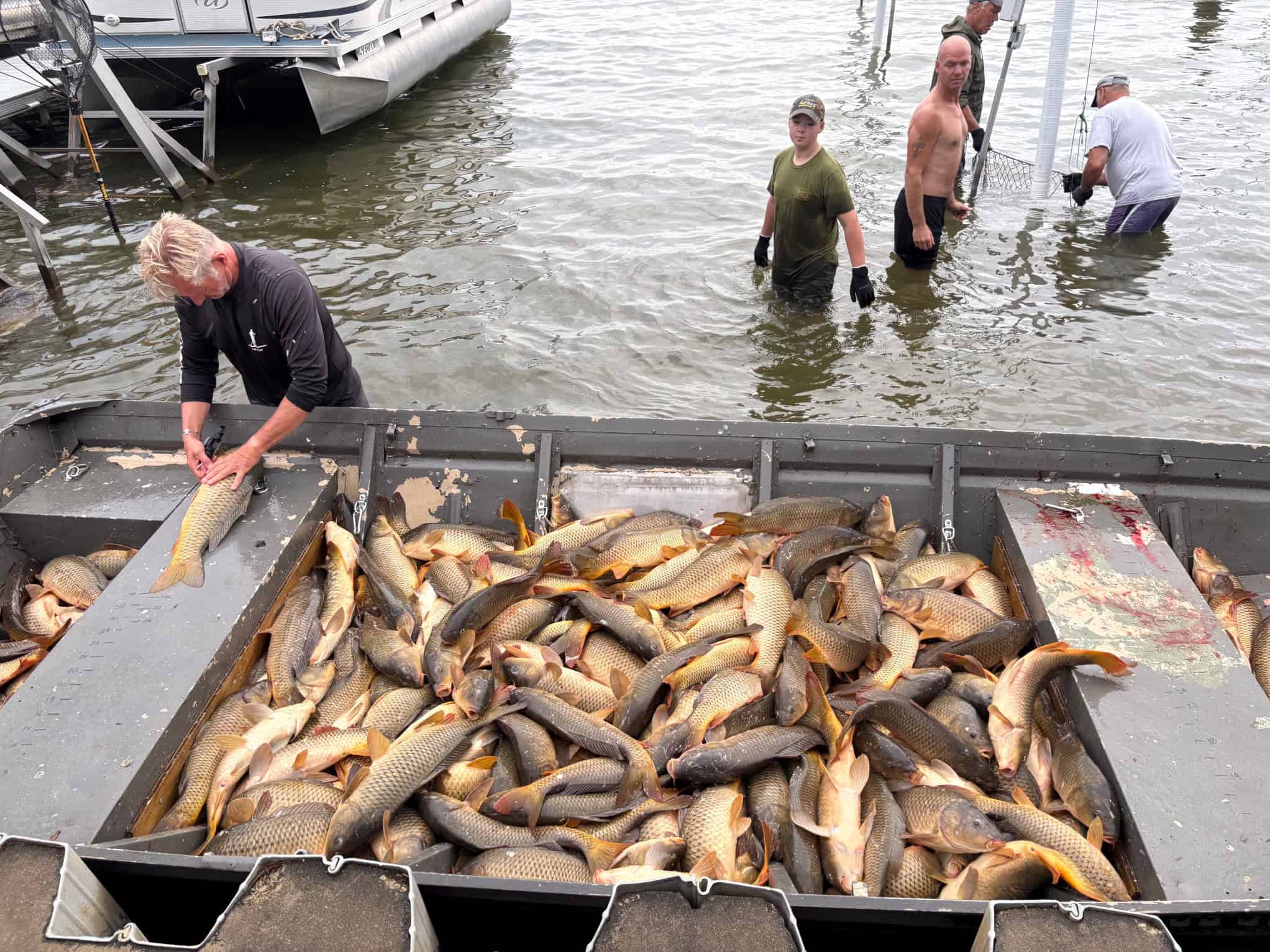
Over the last few years, literally tons of the fish have been baited with cracked corn and drawn to a large net and then boomed into a waiting boat and trailered to a final resting place as compost.
It’s not a job for the faint of heart, unless you enjoy wading into waist-deep water to help move the fish into place, getting you up close and personal with a mess of slimy, scale-covered fish that flip and flop as they’re herded up and into the waiting boat.
I visited the carp culling site on Silver Lake’s east shore one recent Monday morning to see for myself. By 9 a.m., more than two dozen men, women and children had gathered either to work or watch as an estimated 1,200 pounds of the slithering catch was rounded up.
Not everyone was impressed with the effort, namely Sarah Phillips’ three young daughters – Laelyn, 8, Jessa, 5, and Myla, 3. Quipped Sarah, as the scent of carp filled the air: “We’ll stick with chicken.”
Added Tim Beggs, “I’ve never been hungry enough to eat them.”
To be fair, carp aren’t completely inedible. You just have to know how to prepare them. Ask Beggs’ son Walter, for instance: “You have to slow-cook them on a board, smoking ’em until they’re done.
“Then you throw away the fish and eat the board.”
But seriously, invasive carp are no laughing matter. Since the 1800s, when they were imported to North America from other continents, they’ve been dubbed the villains of lakes and rivers in all 48 contiguous states, as well as throughout Canada and Mexico.
While a few recipes abound for carp – and some anglers actually enjoy catching them for sport – they don’t do any favors for the ecosystem. A cursory review of multiple websites all say the same thing: That they severely degrade water quality, destroying habitats and wiping out native fish populations. Their feeding habits and rapid reproduction alter the balance of freshwater systems, shifting healthy lakes into murky, algae-ridden waters.
Unfortunately, they’re terrific at surviving poor water conditions, growing to 40 pounds and beyond 20 years old if allowed to thrive. Then there’s the way they look. But hey, who am I to judge?
Silver Lake’s carp culling exercises began modestly enough – by staging fishing derbies for kids 16 and under. Land a carp, and Friends of Silver Lake (friendsofsilverlake.org) will pay you $2. And here’s $50 to the kid who brings in the most.
Over the course of four Sundays in 2024, that effort netted 117 fish and paid cash to nearly 20 participants. But it was merely a drop in the ol’ bucket.
So the Friends contracted with an outfit in Minnesota to lease a large net that’s anchored by 10 posts and serves as the baiting center. The carp come calling for cracked corn, get caught in the nets, and on successive Mondays throughout the summer months, meet their makers in the form of volunteers who show up to push a makeshift boom so that the fish have nowhere to go but into the boat.
Beggs then trailers the fish to property he owns that doubles as a carp cemetery. Or, “coemeterium,” which is Latin for “burial place.”
The weekly culls take no more than 30 or 40 minutes to complete.
But by all indications, there’s a whole lot more work to be done. Nobody claims to know how many more carp survive in Silver Lake, but one bystander ventured that there could be as many as 900 per acre. And if Silver Lake is just shy of 700 acres in area, that computes to more than 600,000 more carp waiting their turn to meet The Boatman.
I know what some of you are saying, especially when faced with the images accompanying this column: “Oh, those poor carp. What a terrible fate awaits them.”
I hear you. And I heed you. But I have an idea that might help you understand: Dig a big hole in your back yard, add water and then fill it with carp. Feed them cracked corn, keep the Weber nice and hot, and get back to me a year from now.
Let’s meet at Silver Lake. No need for you to wear a name tag. ‘Cause you’ll be the new guy working the net.
Tom Rademacher was a reporter and columnist more than 30 years at The Grand Rapids Press. E-mail him at: rademachertom@gmail.com






0 Comments